



You've just hung your dartboard on the wall, dart in hand, and a doubt sets in: is everything really at the right height? And that line on the floor, it should be a little further away, shouldn't it? Good news, these measurements are not for you to invent. They have been standardized for decades, valid for a world championship as well as for an impromptu game in the garage. We explain everything, directly.
The two numbers to remember first and foremost
If you only have time to remember the essentials, here are the official measurements validated by the World Darts Federation (WDF) and the Professional Darts Corporation (PDC) :
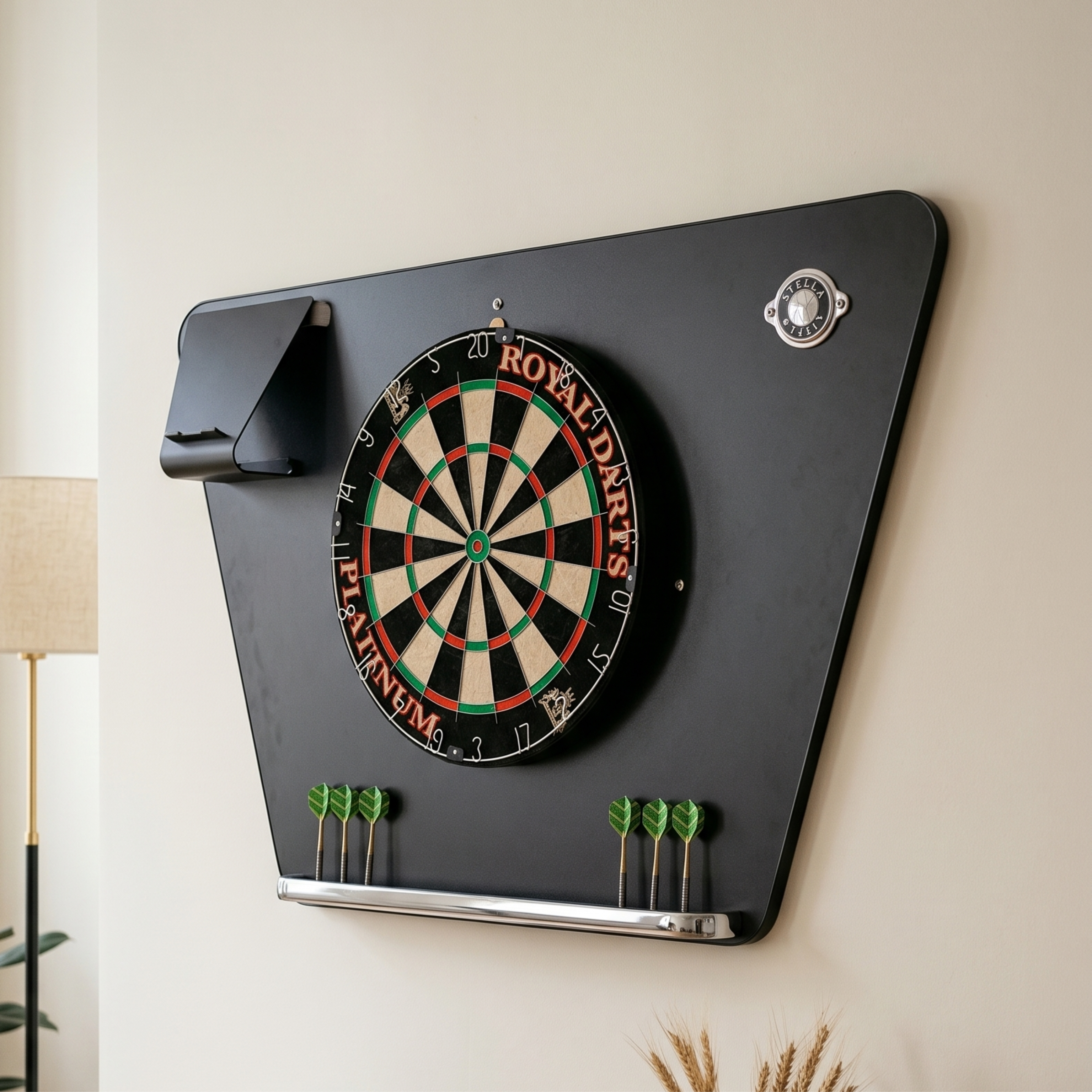
- Dartboard height: 1.73 m from the floor to the center of the bullseye (the red circle in the middle).
- Throwing distance (classic sisal board, steel tips): 2.37 m between the front face of the board and the throwing line, called the oche.
- Throwing distance (electronic board, plastic tips): 2.44 m.
These figures are non-negotiable if you want to make serious progress. A few centimeters too much or too little, and your throw becomes impossible to compare with that of another player, another venue, or another club. It's simply the basis of serious practice, regardless of the level.
How high should the center of the dartboard be placed?
The rule is simple, and the same everywhere in the world: the center of the bullseye must be exactly 1.73 m from the floor. Measure from the finished floor (the one you will be playing on) to the heart of the dartboard, not to the top edge.
This height may seem high for shorter individuals and a bit low for taller ones. That's normal. It historically corresponds to the eye level of an average-height player, and it has become the international standard. Today, you get used to it after a few games. This standard applies to all dartboards: traditional sisal, cork, electronic dartboard. No exceptions.
What if my floor isn't flat?
This is a common case in a converted garage, basement, or barn. If your floor has a slight slope, you must measure on that floor, not on a theoretical plane. The goal is for you, in your room, to play at the correct perceived height. If the slope is steep, it's better to plan for a platform or a thick mat at the throwing line.
How far back should you stand to throw?
This is where things get a little more nuanced, because it all depends on the type of dartboard you are using at home.
Traditional sisal dartboard (steel tips)
The official distance is 2.37 m, measured on the floor in a straight line, from the front face of the dartboard (not the wall, be careful) to the back of the throwing line. This is the famous oche, an English word whose origin is lost between pubs and historical federations.
This distance corresponds to 7 feet 9¼ inches, the original unit. Your feet must remain behind the oche at the moment of throwing. Stepping over, even by a few millimeters, is cheating (and real players spot it immediately).
Electronic dartboard (plastic tips)
As soft-tip darts are lighter and their trajectory faster, the official distance has been extended to 2.44 m. This standard is notably used by the NDA (National Darts Association) and international soft darts leagues. Keep this in mind if you regularly switch between dartboard types: your throwing benchmarks are no longer quite the same.
The pros' tip: diagonal measurement
This is a detail that few amateur players know, and yet it changes everything during installation. Once the dartboard is hung and the line drawn, you can check that everything is perfect with a single measurement: the diagonal between the center of the bullseye and the back of the oche on the floor.
- Steel dartboard (classic): the diagonal must measure exactly 2.93 m.
- Electronic dartboard: the diagonal must measure 2.98 m.
This is simply the Pythagorean theorem applied to darts. If the diagonal is correct, it's mathematical: your height and horizontal distance are both perfect. Conversely, if the diagonal is too long or too short, at least one of the two measurements (height or distance) must be corrected. A simple tape measure stretched across is enough to check in ten seconds.
How much space should be planned around the dartboard?
Even before attaching anything, look at your room. A dartboard needs air around it, for the comfort of the players and for the safety of nearby furniture and walls.
- Minimum length: approximately 3 meters of clear wall in front of the dartboard, so you can step back a bit without bumping into a sofa or table.
- Minimum width: 1.50 m on each side of the dartboard, and ideally more if several people are playing at the same time.
- Ceiling height: at least 2.20 m, to avoid high trajectories ending up in a light fixture.
A clear wall, no traffic behind the thrower, well-placed lighting so as not to cast the player's shadow on the dartboard: these details make the difference between an amateur setup and a real game corner.
Is a mat or throwing line on the floor necessary?
Not mandatory, but frankly recommended. A dart mat plays a dual role: it marks the throwing line (the famous oche) so that no one cheats, and it protects your floor from bouncing darts (and there will be some, even among the best players).
Most mats on the market are 2.95 m long and already include the official markings for both distances (steel and electronic). This is a smart purchase to go into "really set up" mode without having to stick adhesive tape to the floor.
Adapting distances for children and juniors
The official rule does not change for women in competition (same distances as men), but many amateur leagues allow shorter distances for juniors and children. This is an excellent idea at home: 2.37 m is long for an 8-year-old.
Commonly practiced distances for "family" versions:
- Teenagers and beginners: 2.32 m (or 7 feet 6 inches).
- Children aged 8 and over: 2.13 m (or 7 feet exactly).
- Younger children: to be adapted, and always with plastic-tip darts for safety.
The goal at home is not competition. It's to bring everyone together around the game. Adapt without hesitation.
Summary of official measurements
| Measurement | Traditional dartboard (steel) | Electronic dartboard (plastic) |
|---|---|---|
| Bullseye height | 1.73 m | 1.73 m |
| Floor distance (oche) | 2.37 m | 2.44 m |
| Diagonal check | 2.93 m | 2.98 m |
| Dartboard diameter | 45 cm (official) | Variable |
Choosing your dartboard wisely: a final word
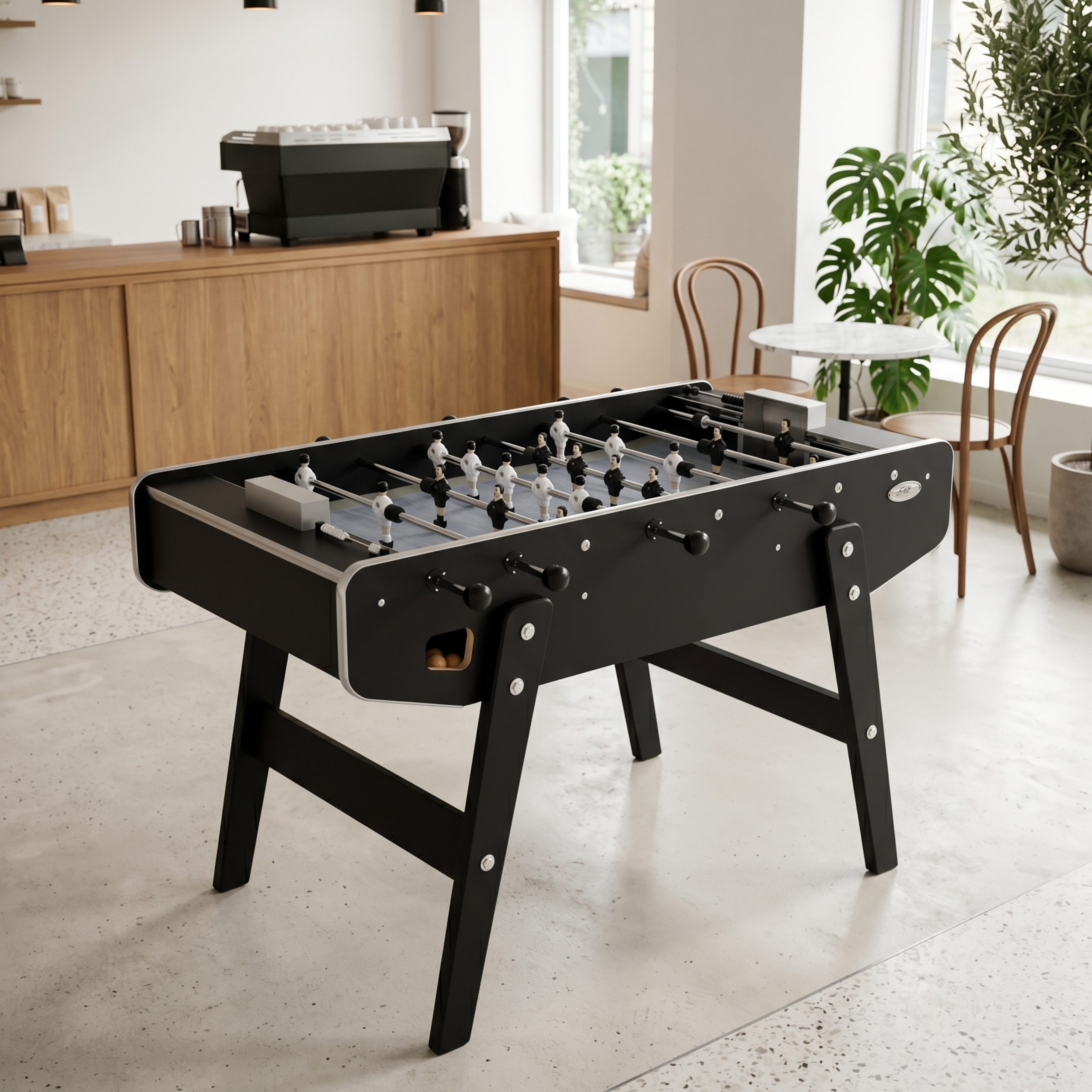
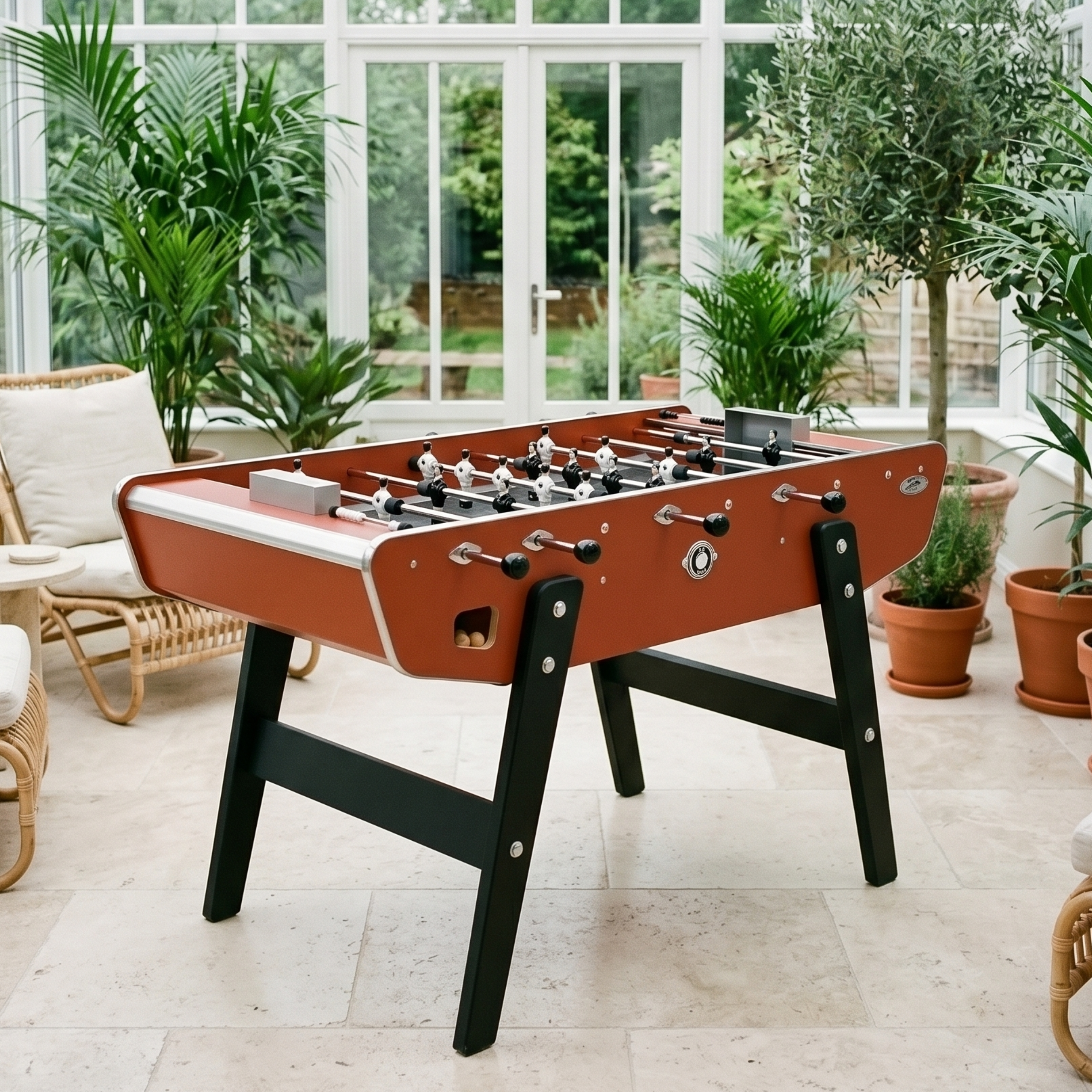
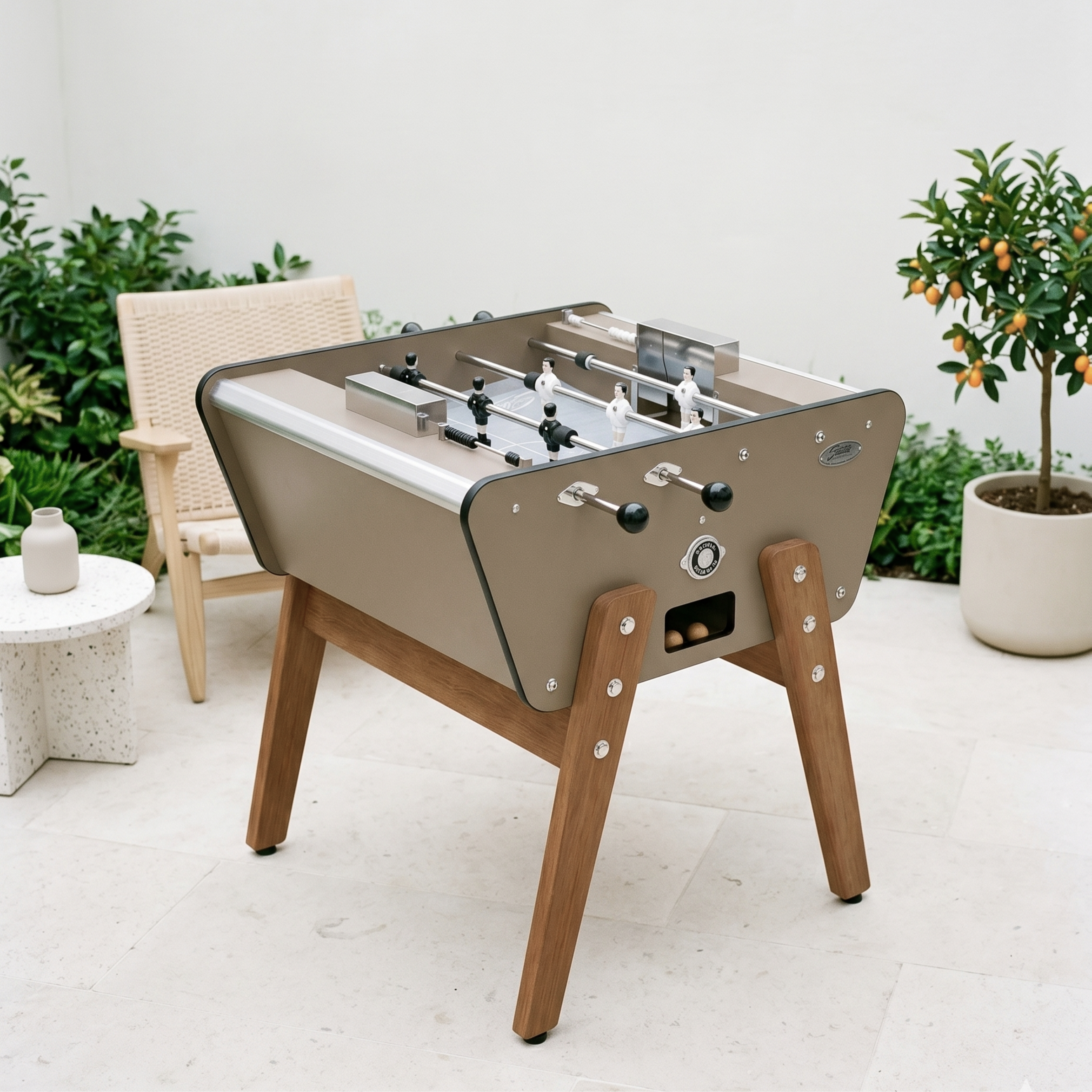
A dartboard with the correct measurements is one thing. A durable dartboard is another story. At Wooderna, we are convinced that a dart game deserves the same attention as a beautiful foosball table: noble wood, careful craftsmanship, an object made to last and to become a landmark in your interior. Because ultimately, a game of darts is above all about shared moments. And these moments deserve a beautiful setting.
Discover our selection of dartboards and accessories, designed to fit into your living room, office, or relaxation area without compromising on quality.
Frequently Asked Questions
Exactly how high should a dartboard be hung?
The center of the bullseye should be 1.73 m from the finished floor. This height is valid for all types of dartboards (sisal, cork, electronic) and is identical worldwide, in competition as well as at home.
What is the official distance for playing darts?
It depends on the type of dartboard: 2.37 m for a traditional steel-tip dartboard, and 2.44 m for an electronic plastic-tip dartboard. The measurement is taken from the front face of the dartboard to the back of the throwing line.
How can I check if my dartboard is correctly installed?
Stretch a tape measure from the center of the bullseye to the back of the oche on the floor. The diagonal should measure 2.93 m (steel dartboard) or 2.98 m (electronic dartboard). If the diagonal is correct, your installation is perfect.
Can you play darts at a different distance at home?
Nothing prevents you from doing so, especially with family or young children. Many amateur leagues allow 2.32 m for juniors and 2.13 m for children. However, to compare scores or make serious progress, it is best to respect the official distances.
What minimum space should be provided for installing a dartboard?
Allow at least 3 m of length in front of the dartboard, 1.50 m of width on each side, and 2.20 m of ceiling height. Avoid passages behind the player and ensure good lighting so as not to create a shadow on the dartboard.


