








Cornhole is a popular game that appeals to many indoor and outdoor leisure enthusiasts. Whether you want to liven up evenings with friends, family events, or simply discover a new challenge, understanding cornhole gameplay is essential. This comprehensive guide in English presents the official rules, equipment, strategies, and everything you need to know to fully enjoy this friendly and accessible game.
What is Cornhole? Game Overview
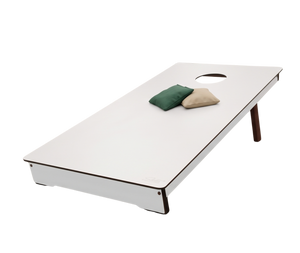
Originating in the United States, cornhole has become an iconic game at barbecues, parties, and competitions. Its name comes from the corn, traditionally used to fill the bags that are thrown. The principle is simple: each player tries to throw bags filled with kernels onto an inclined board with a round hole at the top. The main objective is to score as many points as possible by getting these bags either on the board or directly into the hole. Accessible to all levels, the game combines skill and strategy, making each game exciting, whether you are a beginner or an experienced player. To learn more about this captivating game, visit our page dedicated to Cornhole.
Official Cornhole Equipment: Boards and Bags
Official cornhole equipment is very precise. Boards must measure exactly 120 cm long by 60 cm wide, with an incline that facilitates the bags' slide. The round hole, with a diameter of 15 cm, is positioned 25 cm from the top edge of the board, horizontally centered. As for the bags, they are generally 15 cm square, weigh between 400 and 450 grams, and are filled with synthetic pellets or kernels, depending on preferences or specific rules. Adhering to these dimensions and weights is important to ensure fair play and compliance with official standards. A bag that is too heavy or too light, just like a non-compliant board, can unbalance the game and affect players' performance.
Field Setup and Board Placement
To set up an official court, the boards are placed face-to-face with a regulatory distance of 8.23 meters (27 feet) between the front edges of the boards for adults. This distance can be reduced for children or junior players to adapt the difficulty. The court must be flat, stable, and clear, ensuring safety and comfort during the game. Around each board is an area called the pitcher's box, delimited by foul lines. These elements structure the official game by defining where and how the player must throw their bags, thus avoiding any ambiguity or possible cheating.
How to Play Cornhole: Official Game Rules
Cornhole is played in singles (two players) or doubles (four players divided into two teams). Each player takes turns throwing four bags. The throw must be made from the pitcher's box, without exceeding the foul line: the player's front foot must not cross the front edge of the board. After all bags are thrown, points are calculated. Then, players switch sides for a new round. Before the game, a coin toss determines which team or player will throw first, a significant strategic advantage. This rotation ensures a smooth and fair game until the end of the match.
Detailed Rules for Throwing and Fouls to Avoid
Several fouls can occur during cornhole. For example, the player must never step over the line when throwing. Throwing a bag before the designated signal or illegally touching bags in play are also infractions. Dead bags are those that touch the ground before the board or do not remain on it; they are immediately removed from the game and do not score any points. Any modification of the bags, such as added weight or alteration of the material, is prohibited and can lead to disqualification. In official tournaments, a referee ensures strict adherence to these rules and severely penalizes any serious infraction, guaranteeing the integrity of the game.
The Cornhole Scoring System: Calculation and Rules
The cornhole scoring system is simple yet strategic. A bag successfully entering the hole is worth 3 points, while a bag resting on the board is worth 1 point. This method, called "cancellation scoring," means that one team's points are canceled out by the opponent's to get a net score in each round. For example, if team A scores 7 points and team B scores 5, team A gets 2 net points for that round. Only one player or team can score points per inning, which makes the competition intense. The game is won by the first to reach exactly 21 points. If a player exceeds this total, they must drop back to 15 points, which requires caution and tactics in managing scores.
Complete Game Flow and Winning Conditions
A cornhole game progresses in successive rounds, called innings, until a player or team reaches 21 points at the end of a complete inning. Victory is declared only if the difference between scores is at least two points, thus ensuring a clear and undisputed advantage for the winner. Many tactics are used to prevent the opponent from scoring, such as blocking holes or dislodging bags already on the board. This strategic dimension enriches the game, which is not only based on throwing accuracy but also on planning and anticipating future moves.
Common Variations and Specific Rules
Cornhole can be played in singles with one or two boards, or in doubles with four players divided into two teams. For children, distances are reduced, the number of bags often decreases, and some rules are relaxed to encourage enjoyment and discovery of the game. Furthermore, many "house rules" exist, varying by region or club, modifying, for example, distances or certain scoring rules. These adaptations make the game flexible and always accessible, whether with family or in official competition.
Tips for Beginners and Basic Strategies
To start playing cornhole well, it is essential to adopt a good posture: stable, feet firmly planted in the pitcher's box, and a consistent grip on the bag. Throwing accuracy then comes with practice, especially by aiming for the hole or positioning bags on the board to block the opponent's. Knowing how to dislodge an opponent's bag by throwing a bag onto another is a basic but effective tactic. Regularity is acquired with training, so don't hesitate to practice regularly to improve your control and feel in each throw.
Official Cornhole Tournaments and Competitions
Cornhole is governed by several federations, including the American Cornhole Association (ACA), which organize national and international tournaments. These competitions apply strict rules, much more rigorous than in amateur games, particularly concerning equipment, match progression, and time management. Match formats are often longer and more intense with regulated breaks. Participating in these tournaments is an ideal opportunity to progress, meet other players, and experience cornhole in its most competitive and exciting form.
FAQ: Answers to Frequently Asked Questions about Cornhole
What is the distance between the boards? For adults, the regulatory distance is 8.23 m (27 feet). For children, it is reduced to facilitate the game.
How many bags per player? Each player throws 4 bags per round.
How to interpret exceeding the score? If a player exceeds 21 points, their score is reset to 15 to continue the game.
Can you play with two people with only one board? Yes, but the official game is always played with two boards facing each other to comply with the rules.
Are house rules valid? They are accepted in amateur play, but official tournaments always use the official game rules of 2026.
Glossary of Essential Cornhole Terms
| Term | Definition |
|---|---|
| Inning | A round of play during which each player throws their bags. |
| Dead Bag | A bag that does not stay on the board or touches the ground, excluded from the score. |
| Foul Line | The limit that the player's foot must not cross during the throw. |
| Pitcher's Box | The delimited area from which the player makes their throw. |
| Cancellation Scoring | A system where opponent's points cancel out those obtained in an inning. |
| House Rules | Local or personalized rules different from official rules. |
| Dead Bag Rule | A rule defining which bags are removed from the game due to a foul or position. |
| Board Distance | Official distance between boards (27 feet / 8.23 m). |


